
MeasurE. Report. VerifY At Every Scale.

CarbonCore's MRV system gives organisations a standardised, auditable framework to quantify their emissions and connect verified carbon data to market action.
The MRV system is the foundation of credible carbon market participation.
Without accurate measurement, reporting is unreliable. Without independent verification, reports are untrustworthy. CarbonCore integrates all three stages into a single, connected platform — removing the friction that has historically made MRV inaccessible to all but the largest organisations.
The 5-step mrv workflow


Select Industry & Emission Source
Step 01Users select their industry category from CarbonCore's pre-configured library, which maps directly to verified, sector-specific emission factors aligned to GHG Protocol and ISO 14064 methodologies. Each source — energy consumption, business travel, transport, waste, industrial processes — is categorised and quantified using standardised inputs.

Submit Emissions Data
Step 02For each emission source, users input quantity data (kWh, kilometres, tonnes, hectares). The system automatically calculates CO₂ equivalent emissions (tCO₂e) using the relevant Net Calorific Value (NCV), emission factor, and oxidation factor. Multiple sources across multiple industries can be submitted in a single reporting session.

Preview & Confirm
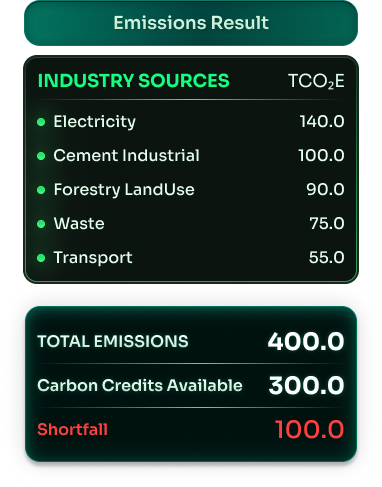
Step 03Before submission, users review a full Emissions Result table — showing each source, unit, and calculated tCO₂e — alongside a total emissions figure. This preview stage provides a final quality control checkpoint before data is locked and submitted.

Shortfall Identification
Step 04Before submission, users review a full Emissions Result table — showing each source, unit, and calculated tCO₂e — alongside a total emissions figure. This preview stage provides a final quality control checkpoint before data is locked and submitted.

Emissions History & Audit Trail
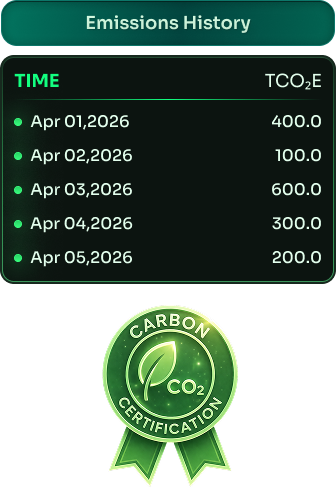
Step 05Every submission is stored in the user's Emissions History with a full timestamped record. Previous submissions can be reviewed at any time in read-only mode — providing a complete, auditable log of emissions data across reporting periods, ready for internal review, regulatory submission, or third-party verification.
MRV DASHBOARD OVERVIEW
The CarbonCore dashboard gives every user a live view of their emissions position across four key indicators: Energy Consumption (MWh), GHG Emissions (tCO₂), Business Travel Emissions (tCO₂), and Scope 3 GHG Emissions (tCO₂). Trend data, Scope 1/2/3 breakdowns, and energy consumption by source type are visualised in real time — giving sustainability teams and compliance officers a single, reliable picture of their emissions footprint.
CarbonCore's Carbon Calculator enables organisations to efficiently and accurately quantify their full organisational carbon inventory across all emission sources. Select your industry, input activity data by source, and the system automatically calculates CO₂ equivalent emissions (tCO₂e) using verified, sector-specific emission factors.
Built on ISO 14064-1 standards for organisational GHG quantification.
Calculation engine draws on a continuously updated emission factors database — each business activity is matched to the appropriate core emission activity and emission factor to ensure accuracy and reliability.
Covers energy consumption (kWh), business travel (km), transport, waste (tonnes), forestry land use (ha), cement and industrial processes, and more.
Supports multi-source, multi-industry submissions in a single reporting session.
CO₂ equivalent output calculated automatically using Net Calorific Value (NCV), emission factor, and oxidation factor per source.
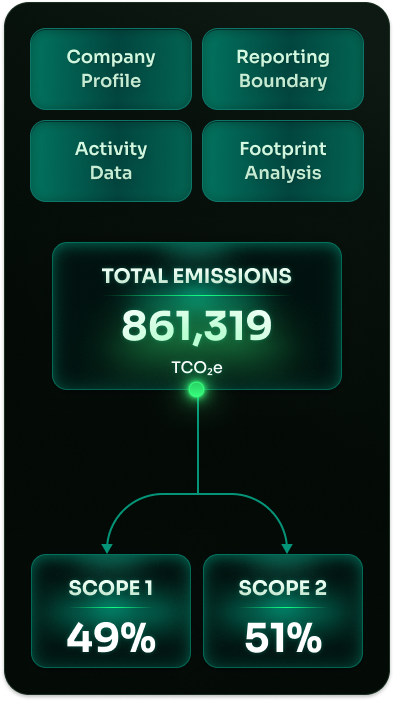
CarbonCore's GHG reporting system provides a structured, audit-ready emissions report across all three scopes — aligned to GHG Protocol Corporate Standard and ISO 14064-1.
Scope 1 — Direct emissions from owned or controlled sources: fuel combustion, industrial processes, company vehicles.
Scope 2 — Indirect emissions from purchased electricity, steam, heat, and cooling.
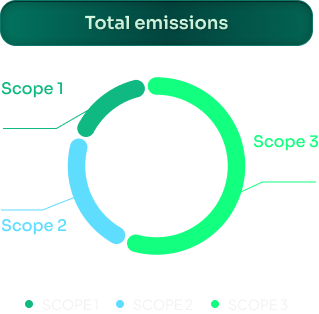
Scope 3 — Value chain emissions including upstream goods and services, business travel, logistics, use of sold products, and upstream leased assets.
Scope breakdown visualised in real time on the dashboard — Scope 1/2/3 split displayed as percentage of total verified emissions.
Every submission timestamped and stored in Emissions History — providing a full, auditable reporting log across periods.
Reports structured for direct submission to internal ESG teams, regulators, or third-party verification bodies.
Upon submission, CarbonCore automatically calculates your emissions shortfall — the gap between total verified emissions and available carbon credits — and connects you directly to the credit purchase pathway.
Total Emissions (tCO₂e) vs Carbon Credits Available (tCO₂e) displayed side by side.
Shortfall (tCO₂e) calculated instantly and flagged in the results view.
Where a shortfall exists, users are routed directly to Purchase Credit — no manual handoff, no separate workflow.
Eliminates the gap between emissions measurement and market action.
Full shortfall history recorded per reporting period for trend analysis and forward planning.
CarbonCore supports organisations in achieving recognised carbon footprint certification — providing the structured data outputs, audit trail, and verification-ready documentation required by leading certification bodies.
Product carbon footprint (CFP) and organisational carbon footprint reporting supported.
Data outputs structured to meet ISO 14064-1 and ISO 14067 certification requirements.
Full digital audit trail maintained from data input through to verified output — every data point timestamped on-chain.
Verification-ready reporting packages exportable for submission to accredited third-party verification and validation bodies (VVBs).
Supports export to and Verra/VCS registry submission requirements.
CarbonCore's Decarbonisation Rating gives organisations a structured, data-driven assessment of their emissions reduction trajectory — translating raw MRV data into an actionable performance indicator.
Rating derived from verified emissions data across reporting periods — tracking directional progress toward net-zero targets.
Scope 1, 2, and 3 trends analysed over time, with year-on-year comparison against baseline.
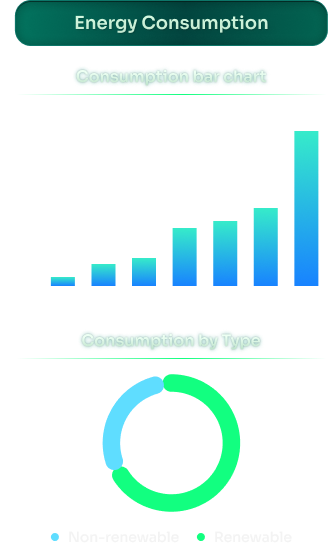
Energy consumption by source type (renewable vs non-renewable) factored into rating calculation — incentivising clean energy transition.
Rating designed to support internal sustainability reporting, investor ESG disclosure, and regulatory compliance frameworks.
Dashboard displays energy consumption trend from 2017–2025, renewable energy mix, and consumption intensity metrics in real time.
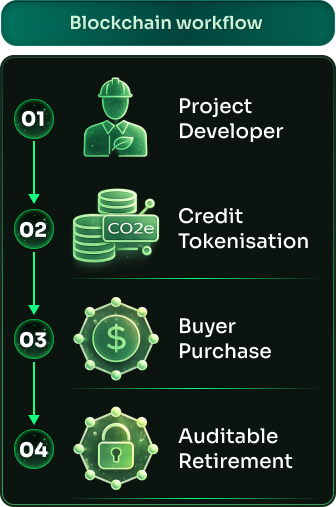
CarbonCore connects verified emission reduction projects to buyers through a structured carbon credit marketplace — enabling transparent price discovery and direct market access for all user tiers.
Carbon credits issued through CarbonCore's MRV-verified project pipeline are eligible for listing on the marketplace.
Tokenised carbon credits carry full on-chain provenance: project origin, verification status, issuance date, and credit volume.
Auction and direct purchase mechanisms available — supporting both spot transactions and forward credit agreements.
Carbon Pools aggregate credits from smaller projects, enabling SMEs and municipal-scale project developers to access buyer demand at scale.
All credit retirements permanently recorded on-chain — publicly verifiable proof of offset, no double-counting.
SUMMARY STATS BAR
326M
Total transactions
11K
Last Carbon Retired (tCO₂)
154K
Total Carbon Retired (tCO₂)
All figures reflect on-chain recorded activity across the CarbonCore framwork.